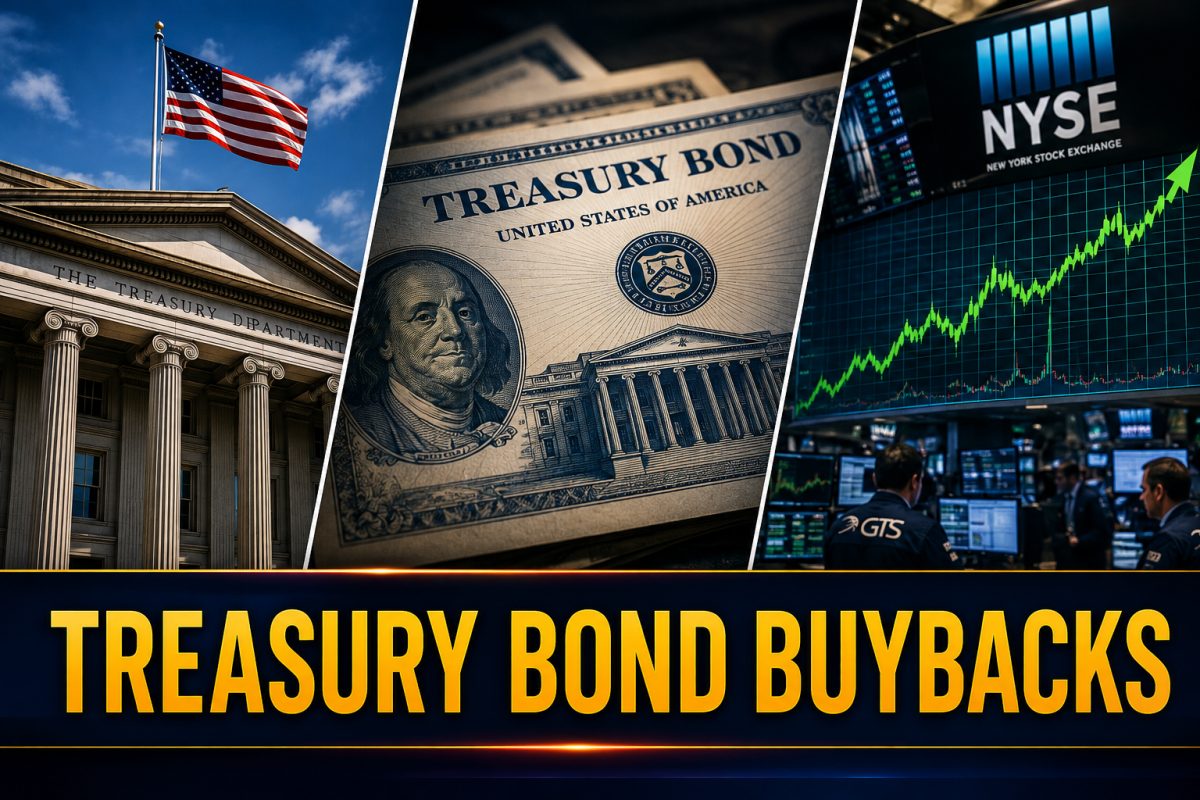

Treasury Department's expanded buyback program eases yield pressure and lifts equities after weeks of bond-market stress.
U.S. stocks rose on Wednesday, Aug. 19, 2026, after the Treasury Department announced it would at least double the size of its buyback operations for longer-dated Treasury securities, a move that eased pressure on long-end yields and helped Wall Street snap a three-session losing streak. The announcement, attributed to Treasury Secretary Scott Bessent's department, raised the ceiling for liquidity-support buybacks from $2 billion to at least $4 billion per operation, targeting bonds in the 10- to 20-year and 20- to 30-year sectors. The program is set to begin Sept. 9 and run through Nov. 4.
The move came as long-term Treasury yields had climbed to levels not seen in roughly 19 years, rattling investors amid growing concerns over swelling sovereign debt. Reuters described the buyback expansion as a measure that "staunched at least temporarily a weeks-long upward march in yields" that had unnerved global markets. The Times of India's coverage framed the reaction similarly, reporting that Wall Street edged higher after Treasury said it could increase its purchases of government bonds, easing some of the pressure weighing on financial markets worldwide.
View this post on Instagram
Treasury's Liquidity Move Targets the Long End of the Curve
The Treasury Department said the increased buybacks are intended to "provide greater liquidity support in longer-dated nominal sectors where there is consistent strong sponsorship from market participants," according to the announcement as summarized by the Post-Gazette. The action does not touch short-dated bills and is not a change in Federal Reserve monetary policy; it is a Treasury debt-management operation aimed specifically at stabilizing the 10-to-30-year segment of the bond market that had seen a sharp selloff in recent weeks.
Coverage from Reuters, Seeking Alpha and other outlets confirmed the operational details: the buyback ceiling doubles from $2 billion to at least $4 billion per operation, covering the 10- to 20-year and 20- to 30-year sectors, with the expanded schedule running from Sept. 9 through Nov. 4. The Treasury described the increase as being of at least double the prior size, leaving open the possibility that individual operations could exceed the new $4 billion floor.
Long-Dated Yields Fall Sharply After the Announcement
The most immediate and consequential market reaction was a drop in long-dated U.S. Treasury yields. Reuters reported that the benchmark 10-year Treasury yield fell 5.1 basis points to 4.655%, while the 30-year bond yield dropped 8.9 basis points to 5.196% in afternoon trading. An earlier Reuters update said the 30-year yield fell almost 10 basis points to 5.188% before rebounding slightly to 5.208%.
A separate Reuters market report said long-dated U.S. government yields fell by as much as 10 basis points overall, a move one Reuters wire report called the biggest single-day fall since October 2025. The declines mark a sharp reversal from the prior session, when yields had been trading near their highest levels in almost two decades, driven by investor anxiety over rising sovereign debt levels.
The bond-market relief extended beyond Treasuries. Reuters reported that the U.S. dollar weakened and gold jumped following the Treasury's announcement, signaling a broader cross-asset response to the policy shift. Analysts covering the move characterized it as a temporary backstop rather than a permanent overhaul of federal debt-management policy, designed to calm markets rather than address the underlying fiscal pressures driving the yield increases.
Wall Street Rebounds From Recent Weakness
Equity markets responded positively to the easing of yield pressure. The Times of India reported that the Dow Jones Industrial Average rose 65 points, or 0.1%, as of 9:35 a.m. Eastern time, while the Nasdaq composite added 0.2% in early trading. Reuters separately reported the Nasdaq composite up 0.4% later in the session as the rally gained momentum.
CNBC's live market coverage said the S&P 500 snapped a three-session losing streak, with stocks rallying as yields on longer-dated Treasurys pulled back from multi-year highs after the government unveiled its plan to ease pressure from the recent bond-market rout. Yahoo Finance reported the Dow rose about 230 points during the session, crediting the expanded buyback program with helping send long-dated yields lower and restoring investor confidence.
Context Behind a Weeks-Long Bond Market Rout
The backdrop to Wednesday's announcement was a sustained period of pressure on the long end of the bond market. Reuters described yields as having approached their highest levels in 19 years, with investors growing increasingly concerned about swelling sovereign debt and its implications for future borrowing costs. That upward march in yields had been unsettling global markets for weeks before Treasury's intervention.
Reuters and other wire services framed the buyback expansion as a liquidity-support measure aimed narrowly at stabilizing the parts of the market that had experienced the sharpest selloff, rather than a broader shift in fiscal or monetary strategy. The distinction is significant: the action reflects a debt-management tool available to the Treasury Department, separate from interest-rate decisions made by the Federal Reserve. Markets nonetheless treated the announcement as meaningful enough to reverse a multi-day slide in equities and produce one of the sharpest single-day yield declines in months.