
New Delhi challenges Washington at the WTO after a four-year US safeguard measure imposes duties of up to 55% on quartz surface product imports from India.
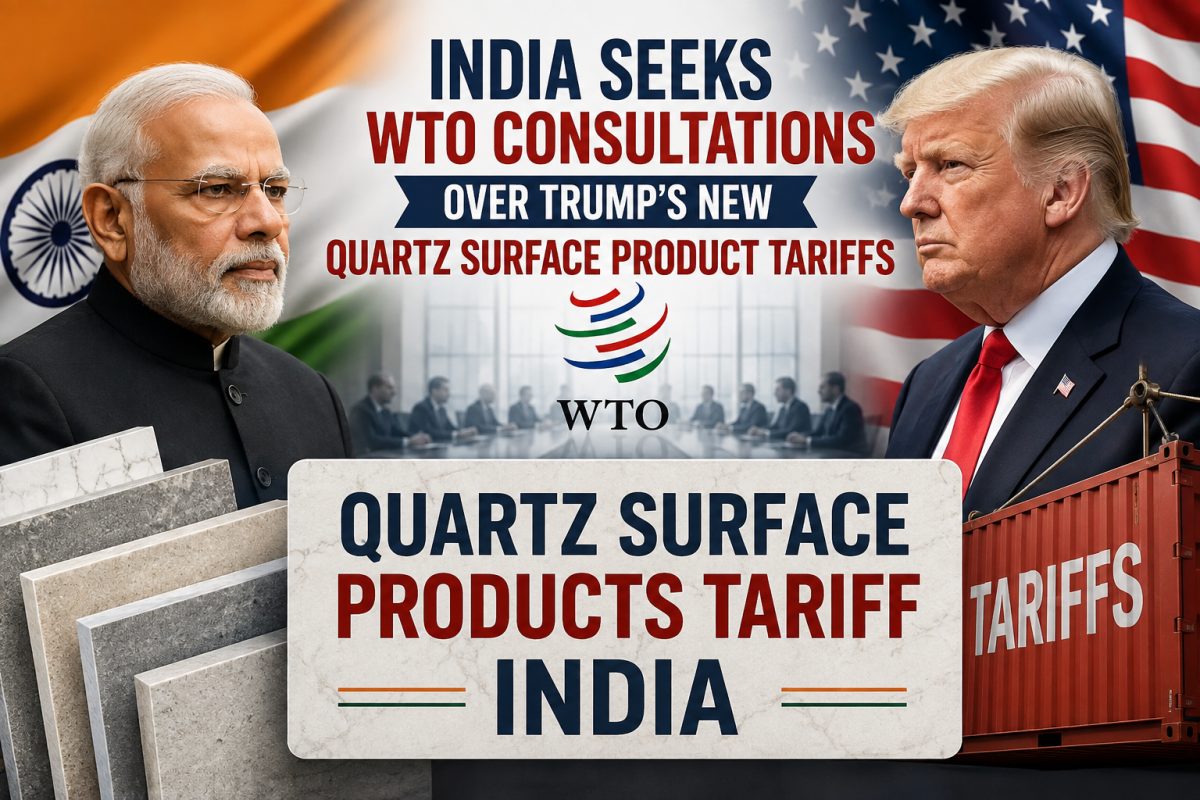
India has formally requested consultations with the United States at the World Trade Organization over a new safeguard tariff measure that imposes steep duties on quartz surface products, a sector where the American market accounts for nearly three-quarters of India's export earnings. The request, filed on August 14, 2026, follows a presidential proclamation signed by US President Donald Trump on July 31, 2026, which created a four-year Section 201 safeguard tariff-rate quota on most imports of quartz surface products, effective from August 15, 2026. India is not exempt from the measure and has not been granted a country-specific quota, exposing its exporters to duties that can climb as high as 50 to 55% once quota limits are exhausted.
The proclamation covers quartz surface products classified under specific US tariff codes, including engineered-stone and quartz countertop slabs widely used in construction and home renovation. Under the safeguard structure, imports within the global quota face an additional 25% duty in the first year, while shipments exceeding that quota face duties of up to 50%, with some sources citing a range as wide as 40 to 55% depending on classification and timing. The measure is scheduled to run for four years, through August 14, 2030, with quota volumes rising and duty rates declining marginally each year.
Scale of India's Exposure to the US Market
According to a report by the Global Trade Research Initiative, a Delhi-based trade think tank, the United States accounted for approximately 72.5% of India's quartz surface-product exports in the 2026 fiscal year. India's exports of these products to the US were valued at roughly $233 to $234 million during that period, underscoring how heavily the sector depends on a single market.
GTRI and other trade analysts describe India's quartz surface-products industry as fundamentally export-oriented, with production capacity built largely around US demand. That concentration means the safeguard tariffs are expected to hit Indian manufacturers disproportionately compared with suppliers who have more diversified export markets or who benefit from exemptions under the US proclamation, such as Canada, Mexico, South Korea and Australia.
India's WTO Consultation Request and Possible Arguments
India's move to seek consultations under the WTO Agreement on Safeguards marks the first procedural stage of a potential trade dispute, not a formal complaint in itself. Consultations are intended to clarify the measure and explore possible solutions between the two countries before any escalation. India retains the option to request a WTO dispute panel later if consultations do not produce a satisfactory outcome, though that step has not been taken.
During consultations, India is expected to question the US assessment of increased imports and the finding of serious injury to American producers, both of which are required under WTO rules to justify a safeguard measure. Trade experts also anticipate India will challenge the design of the tariff-rate quota itself, particularly the absence of an India-specific allocation, and may seek an exemption, a dedicated quota or reduced duty rates as part of the process. These remain expected strategies based on expert commentary rather than confirmed demands, as India's detailed legal arguments will emerge as the case develops.
The quartz dispute is reported to be at least the fourth recent instance of India challenging US trade measures at the WTO, reflecting a broader pattern of friction between the two countries even as they continue to negotiate wider trade and strategic ties.
Structural Details of the Safeguard Measure
The safeguard operates as a tariff-rate quota, with a global quota volume divided into four quarterly allocations during its first year. That first-year global quota is set at 13.006 million square metres, covering all non-exempt countries competing for access to the US market. Once the quota is exhausted, all subsequent shipments face the higher over-quota duty rate until the next allocation period begins.
Quota volumes are set to increase gradually and duty rates to decline modestly, by roughly one percentage point annually, over the four-year life of the measure. However, analysts note that even with these scheduled reductions, tariff levels are likely to remain high enough to discourage significant import volumes unless India secures concessions through the WTO process. The safeguard duties apply on top of standard US import duties and any existing anti-dumping or countervailing duties already in place on specific countries such as China.
Commercial Consequences for Indian Exporters
With no dedicated quota carved out for India, Indian exporters must compete directly with other non-exempt supplying countries for shares of the global quota. Once quarterly allocations are used up, Indian shipments face the full over-quota duty, placing them at a significant competitive disadvantage against domestic US producers and against exempt countries such as Canada and Mexico, whose exports face no safeguard tariff at all.
GTRI and other analysts have characterized the measure as a major new market-access barrier for a sector where more than 70% of sales depend on the US, warning of potential risks to factory operations, employment and future investment in India's quartz industry. Indian firms may need to consider repricing exports, diversifying into alternative markets such as the European Union or the Middle East, or examining product classification changes where legally permissible to reduce their exposure to the new duties.