
UAE says no casualties in latest ADNOC tanker attack as Gulf states demand Iran halt Strait of Hormuz strikes
The United Arab Emirates has accused Iran of attacking a tanker linked to the Abu Dhabi National Oil Company (ADNOC) with a missile as the vessel transited the Strait of Hormuz, according to reporting published in early August 2026. The UAE Foreign Ministry said no casualties resulted from the strike, and Gulf and Arab governments swiftly condemned the incident. Abu Dhabi described the attack as an act of piracy carried out by Iran's Revolutionary Guard, according to Al Jazeera's coverage of the episode.
The August incident is the latest in a monthslong pattern of attacks on commercial shipping in the strait, one of the world's most critical energy corridors. The UAE has repeatedly accused Iran of targeting its national oil tankers since at least May 2026, and each incident has drawn similar language from Emirati officials describing the strikes as violations of international law and threats to global trade.
A Pattern of Escalating Attacks Since May
Reuters reported on May 4, 2026, that the UAE accused Iran of attacking an empty ADNOC crude tanker, the Barakah, with drones as it attempted to pass through the Strait of Hormuz. ADNOC's maritime energy logistics unit said no injuries resulted from that strike. The UAE at the time called the assault unprovoked and demanded Iran's full commitment to an immediate cessation of hostilities along with the complete and unconditional reopening of the strait.
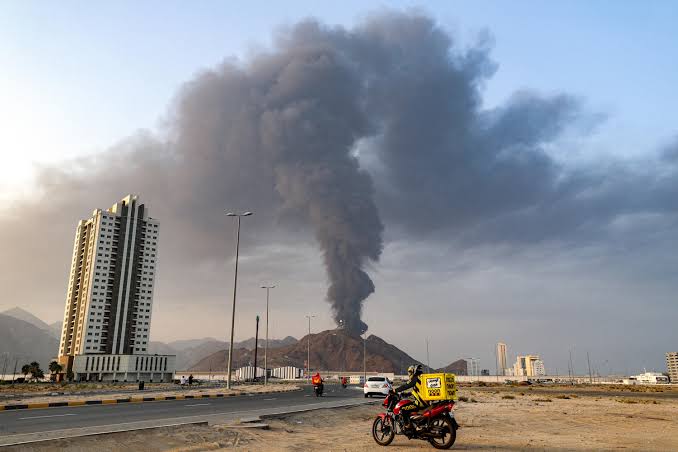
That same reporting cycle included UAE Ministry of Defence statements describing missile and drone barrages that set an oil refinery ablaze in Fujairah and wounded three Indian nationals, according to Al Jazeera and BBC coverage from May 2026. The UAE's air defences said they had engaged a dozen ballistic missiles during that episode, underscoring the scale of the confrontation even before the more recent tanker strikes.
The situation escalated further in July 2026, when the UAE said two Emirati oil tankers, the Mombasa and Al Bahiyah, were struck by Iranian cruise missiles while transiting the southern shipping lane of the Strait of Hormuz within Omani territorial waters. The UAE Ministry of Defence said one Indian crew member was killed and eight others were wounded, four of them seriously, according to Reuters. The UAE Ministry of Foreign Affairs formally condemned what it called "hostile Iranian attacks" in a statement issued July 14, 2026.
UAE's Consistent Diplomatic Demands
Across each incident, the UAE's public statements have followed a consistent pattern. Officials have repeatedly labeled the strikes as acts of piracy and violations of international law, while calling on Iran to halt what it terms unprovoked attacks. The UAE Foreign Ministry has specifically urged Iran to support the "complete and unconditional reopening" of the Strait of Hormuz, language that has appeared in statements from May through August 2026.
BBC reporting from July 2026 noted that Iran's Revolutionary Guard offered its own account of the tanker strikes, claiming the vessels had ignored warnings and entered a mined route. That claim from Iranian military sources remains an allegation and has not been independently verified in the available reporting. The UAE, by contrast, has framed the strikes as deliberate attacks on national assets during normal commercial transit.
Malay Mail reported on August 9, 2026, that even as the UAE condemned the latest tanker attack, Iran and Oman suggested that talks on administering the strait were progressing. That detail suggests parallel diplomatic efforts are underway even as attacks continue, though the outcome of those talks was not detailed in available reporting.
Regional Condemnation and Navigation Concerns
The attacks have prompted condemnation beyond the UAE itself. Al Jazeera reported that Qatar condemned the attack and rejected the use of the Strait of Hormuz as a bargaining chip, calling instead for the waterway to be reopened without conditions. BBC's coverage echoed similar Qatari statements supporting an unconditional reopening of the strait following the strike on the ADNOC affiliated tanker.
These regional reactions indicate that Gulf states are treating the situation as a shared shipping-security concern rather than a strictly bilateral dispute between the UAE and Iran. The Strait of Hormuz serves as the narrow maritime link between the Persian Gulf and the Gulf of Oman, and disruptions there carry direct consequences for international shipping and global energy exports.
The UAE's own statements have consistently framed the issue in terms of freedom of navigation and protection of the global economy, rather than solely as a bilateral security matter. Multiple reports describe the southern shipping lane, including areas within Omani territorial waters, as the specific site of several of the attacks, reinforcing the vulnerability of that stretch of the corridor to repeated strikes.
What Remains Unverified
While the UAE's accusations and official statements are consistently documented across Reuters, Al Jazeera, BBC and the UAE's own Ministry of Foreign Affairs, the reporting reviewed does not include an independent forensic determination confirming Iran's responsibility for the August incident. The strongest confirmed facts for the latest episode are the UAE's formal accusation, the identification of an ADNOC-linked tanker, the Strait of Hormuz location, and the absence of reported casualties.
Details from the July attack, including the death of one Indian crew member and the wounding of eight others, belong to that earlier incident and should not be conflated with the August tanker strike unless further reporting confirms they describe the same event. Iran's own characterization of the tanker movements, including the Revolutionary Guard's claim about a mined route, remains an allegation from Tehran that has not been independently corroborated in the available coverage.